

Foundations
Part of Payroll software in England: what PAYE, pension duties and UK business counts show a supplier
Entering the payroll software market means clearing HMRC, pensions and data hurdles first
Use this England payroll software entry checklist to test customer scope, HMRC reporting, pensions, data protection, migration, support and evidence.
Entering payroll software is not simply a calculation project. The product sits inside recurring employer reporting, workplace pension processes and the handling of sensitive staff records. Complete this checklist against one defined customer segment before widening the offer.
What to take away
- Entering payroll software means meeting HMRC reporting, pension and data protection duties, not just doing calculations.
- Test weekly, irregular and leaver cases rather than assuming one monthly salaried payroll proves a feature works.
- HMRC recognition covers stated technical specifications and must not be marketed as approval of the wider service.
- Reconcile year-to-date values and payroll IDs before the first live run.
- Reopen the checklist before each tax year and material platform change.
Customer and workflow
- Name the first buyer, user and approver separately.
- Record supported employer sizes, pay frequencies and worker types.
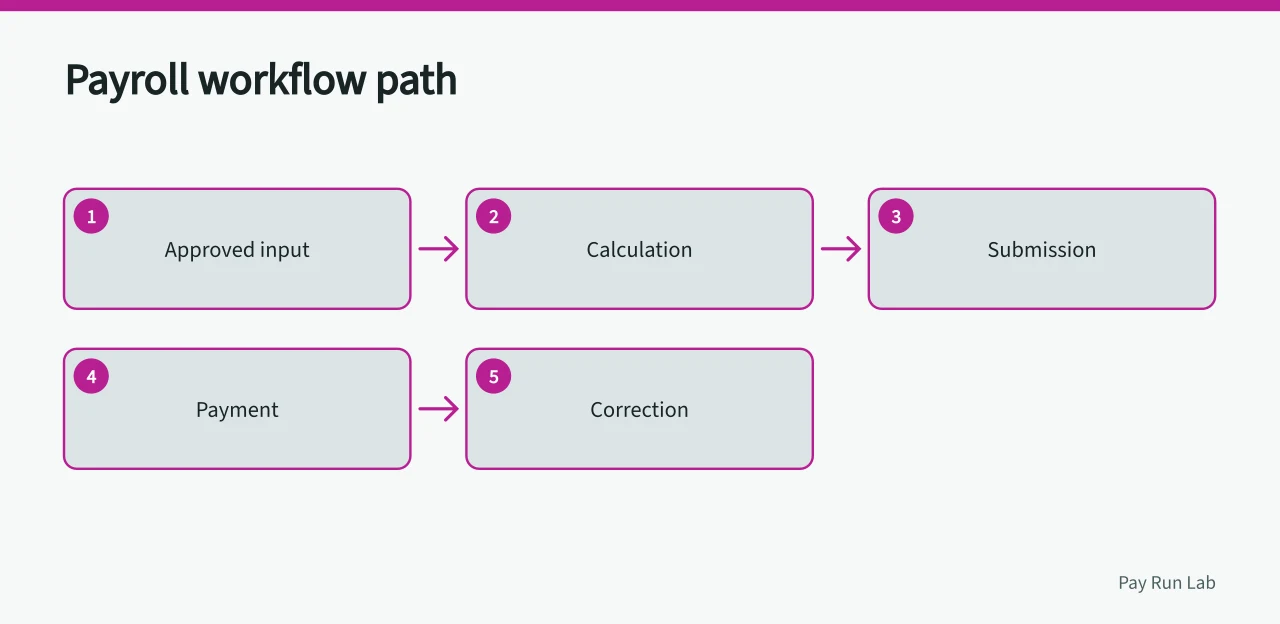
- Draw the path from approved input through calculation, submission, payment and correction.
- List every manual hand-off and late-data scenario.
- Exclude unsupported territories, sectors and employment types explicitly.
Do not call a feature universal because it worked for one monthly salaried payroll. Test weekly, irregular and leaver cases relevant to the chosen segment.
HMRC reporting and change control
- Map Full Payment Submission and Employer Payment Summary fields in scope.
- Test reports against HMRC's software developers' specifications for PAYE and National Insurance contributions.
- Establish a release process for each tax year and in-year change.
- Preserve submission acknowledgements, errors and correction history.
- Decide whether to apply for PAYE software recognition.
HMRC's developer recognition guidance says a product should have completed development and testing before applying. Recognition covers stated technical specifications and leads to listing if successful. It must not be marketed as HMRC approval of the wider service.
HMRC reporting and change control
- Map FPS and EPS fields
- Test against HMRC specification
- Release process per tax year
- Preserve acknowledgements and corrections
- Decide on PAYE recognition
Employers normally report pay and deductions on or before payday. Use the current payroll reporting guidance for field and timing requirements, then retain dated test evidence.
A concrete test case: submit an FPS for one weekly employee with the PAYE reference, pay date, taxable pay to date and total tax to date, then check the year-to-date figures. Pair it with an EPS that reports no payment for a tax month when no wages are due.
Payroll-specific rules belong in the same test plan. FPS is due on or before payday, and an EPS is normally due by the 19th of the month after the tax month it covers. New starters arrive with a P45 Part 3 or a starter checklist, and leavers need a P45.
NI category letters change the arithmetic: A for standard employees, B for a valid reduced-rate election, C for employees over State Pension age.
Workplace pensions
- Confirm which automatic enrolment assessments the product performs.
- Test contribution calculations and the pension scheme's tax-relief method.
- Validate pension-provider data formats and rejection handling.
- Support join, opt-in, opt-out and re-enrolment records where promised.
- Make unsupported communications or decisions clear.
The Pensions Regulator's software checklist stresses current staff records, compatible data transfer and correct tax-relief setup. Product testing should cover these operational links, not just a deduction field.
Personal data and security
- Identify controller, processor and sub-processor roles for each service.
- Document lawful instructions, contracts, retention and deletion.
- Apply least-privilege access and strong administrator authentication.
- Encrypt transfers and protect stored payroll records.
- Rehearse backup restoration, incident response and customer notification.
The ICO explains in its controller and processor guidance that roles and responsibilities depend on real decision-making. Do not rely on a contractual label that contradicts how the service operates.
Migration, support and claims
- Reconcile year-to-date values before the first live run.
- Preserve employee identities and test changed payroll IDs.
- Define support hours around customer paydays and filing deadlines.
- Publish service status, escalation and correction routes.
- Substantiate every claim about savings, accuracy and compliance.
Run parallel payrolls with a small, representative pilot group. Record defects, staff time and interventions. Launch only when the evidence shows that ordinary users can finish the entire supported workflow and recover safely when something goes wrong.
Commercial readiness
- Calculate support and implementation cost from observed pilot work.
- Define the chargeable unit and rules for inactive employees or extra runs.
- Separate software access from managed services in the order form.
- Establish cancellation, data-export and account-closure procedures.
- Check insurance, supplier dependencies and financial runway against the promised service.
Approve entry through named gates for product, tax, pensions, privacy, security, support and finance. A founder's confidence should not substitute for a recorded owner, dated evidence and an unresolved-issue log. Reopen the checklist before each tax year and material platform change.
Common questions
What does HMRC software recognition actually cover?
The developer recognition guidance says a product should have completed development and testing before applying. Recognition covers stated technical specifications and leads to listing if successful. It must not be marketed as HMRC approval of the wider service.
What should product testing cover for workplace pensions?
The Pensions Regulator's software checklist stresses current staff records, compatible data transfer and correct tax-relief setup. Product testing should cover these operational links, not just a deduction field. Also test contribution calculations, provider data formats and rejection handling.
How should a team decide when to launch?
Fix a dated go-live gate, record the evidence required, and launch only when a named owner has signed it off.