

Rules and ethics
Part of Payroll compliance in 2027 starts with a map of the rules, not a marketing claim
Payroll software contracts should settle who does what before anyone is paid
Scope payroll software commercial contracts in England around services, customer inputs, data, support, change, liability, payment and exit.
Payroll software commercial contracts in England should describe the operational relationship before something goes wrong. A generic software licence rarely explains who approves data, submits reports, releases payments, handles pension files and corrects errors. Obtain English legal advice for the actual parties, service and exposure.
What to take away
- A payroll software contract should set out who approves data, submits reports and releases payments.
- The employer's legal obligations remain even when a managed service performs agreed payroll steps.
- Liability clauses need legal advice because controls and a reasonableness test may apply.
- Plan exit terms, export formats and outstanding payroll duties before signing the contract.
- Keep a contract-to-control matrix linking each promise to an owner and evidence.
Identify the parties and service
Use full legal names and distinguish the software supplier, reseller, implementation partner, managed-service operator and customer. Suppliers such as Sage, Xero, BrightPay, IRIS and ADP each publish their own standard terms, so the split between supplier and customer is not identical across products, editions or reseller arrangements. Define the product edition, employer and employee limits, PAYE schemes, tax-year support, integrations, service tasks and exclusions.
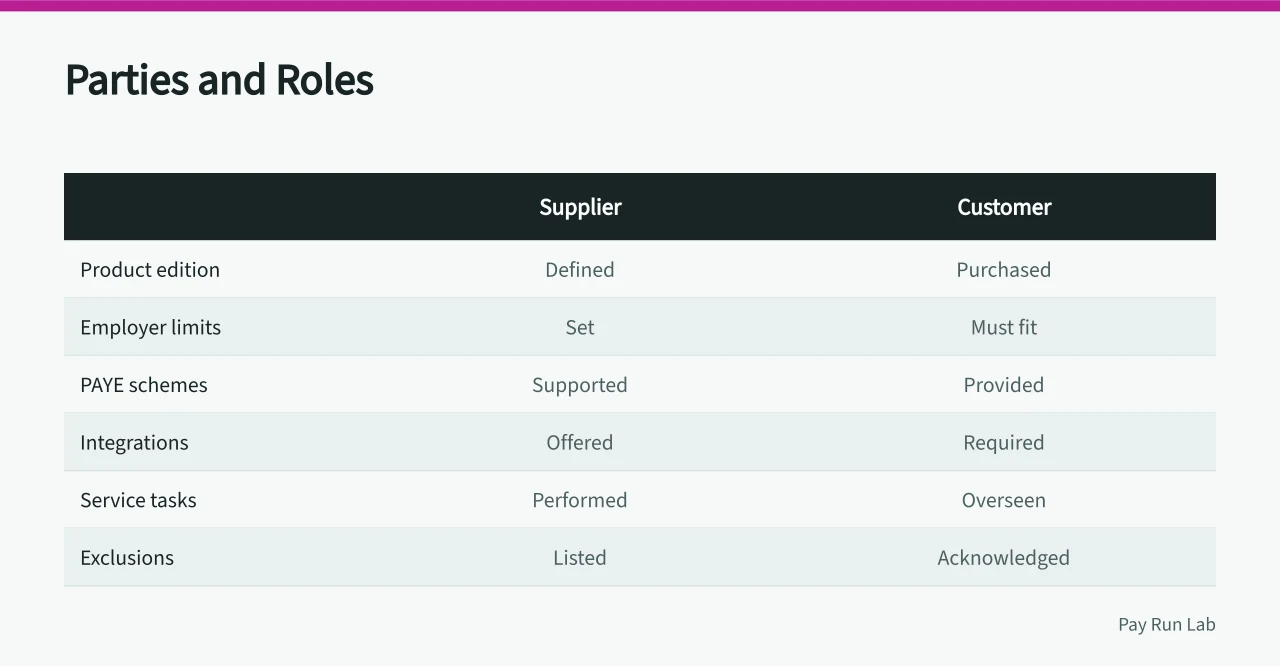
The Office of the Small Business Commissioner's Contract Guide recommends recording who is involved, what is provided, quality or conditions, duration, payment and how the arrangement ends. Its guidance is a practical prompt, not tailored legal drafting.
Allocate payroll responsibilities
State who supplies and validates inputs, approves calculations, submits to HMRC, checks acknowledgements, sends pension data, authorises payments and communicates with employees. Pension work covers assessing workers, enrolling eligible jobholders and deducting contributions under the automatic-enrolment duties supervised by The Pensions Regulator. Set deadlines for customer information and a process for late or changed data.
A model split for a hosted payroll product reads like this:
- Employerholds the employee records, approves the input, corrects errors and remains the legal employer for PAYE and automatic enrolment.
- Software supplierlicenses the calculation engine, issues tax-year updates and provides the support level purchased.
- Managed-service or bureau operatorruns the payroll, sends the Full Payment Submission and Employer Payment Summary to HMRC and issues payslips within the agreed service levels.
- Implementation partnerconfigures the product, migrates opening balances and completes the parallel run before the first live pay run.
HMRC's Real Time Information service expects the Full Payment Submission on or before each payday, with the Employer Payment Summary used for adjustments and nil payments. Write the same matrix into the contract so each of these steps has a named owner.
Payroll Task Allocation
- Supplies and validates inputs
- Approves calculations
- Submits to HMRC
- Checks acknowledgements
- Sends pension data
- Authorises payments
- Communicates with employees
Do not imply that software transfers the employer's legal obligations. HMRC's running payroll guidance describes employer tasks around payday and the following tax month. A managed service can perform agreed steps while responsibility still requires careful legal allocation.
Describe service and change
Set availability measurements around critical payroll functions, scheduled maintenance, support hours, severity, escalation and recovery. Explain how tax-year releases, legal changes, integrations and unsupported operating environments are handled.
Avoid a broad right to change any term or function without notice. Define material change, customer communication, acceptance and any termination option. Record the order of precedence between order form, service terms, data-processing agreement and service levels.
Address personal data
Where a controller appoints a processor, the UK GDPR and the Data Protection Act 2018 require a written contract, and the ICO's contracts and liabilities guidance lists the processing details and minimum terms. Cover instructions, confidentiality, security, sub-processors, rights assistance, incidents, return or deletion and audits.
Commercial confidentiality is not a replacement for data-protection terms. Test whether operational practice can deliver what the contract says.
Price, liability and payment
Define the chargeable unit, active-employee rules, extra runs, migration, support, VAT, invoices, renewal and late payment. Separate software fees from managed work.
Liability clauses need advice. The Unfair Contract Terms Act 1977 contains controls relevant to exclusions and restrictions in stated circumstances, including a reasonableness test for some terms. Applicability depends on facts and cannot be resolved by copying another supplier's cap.
Plan exit before entry
Specify termination triggers, suspension safeguards, notice, transition help, export content and format, retention, deletion and outstanding payroll responsibilities. Test a complete export with safe data.
Maintain a contract-to-control matrix linking each promise to an owner and evidence. Review it at renewal, tax-year change and every significant product update. The agreement is useful only when sales, engineering and support can perform it consistently.
Link the order form to qualification
Record the customer's employee range, pay frequencies, PAYE schemes, pension provider, integrations and planned start date. Make assumptions and exclusions visible beside the purchased service. If discovery reveals an unsupported case, change the scope or decline the order before migration.
Plan the first live pay run separately from the sale. A parallel run against the outgoing payroll, agreed opening balances, sign-off of the first payslips and a cutover checklist make the contract's approval steps and deadlines testable before payday rather than after it.
Avoid allowing marketing copy to expand the signed service. Incorporate only identified documents and preserve the version accepted by both parties. Train sales and onboarding staff on which promises need specialist approval.
Set a dispute and correction process
Describe how a customer reports a suspected error, what information is needed, who investigates and how urgent payroll issues are escalated. Separate correction of software, customer data, HMRC reporting, pension records and payments because authority can differ.
Provide a proportionate route for complaints and disputes, including governing law and jurisdiction after legal review. Keep operational evidence such as approvals, submission responses and support records under a defensible retention schedule. A contract cannot prevent every disagreement, but it can make the facts and next action much easier to establish.
Before you act
- Identify every party and the exact service provided.
- Allocate payroll tasks and set deadlines for customer data.
- Define material change, acceptance and any termination option.
- Check data-protection terms against the ICO guidance.
- Separate software fees from managed work in the price.
- Test a complete export with safe data before exit.
Common questions
Who is responsible for payroll tasks when a managed service is used?
The contract should state who supplies and validates inputs, approves calculations, submits to HMRC, checks acknowledgements, sends pension data, authorises payments and communicates with employees. A managed service can perform agreed steps, including the Full Payment Submission, but the employer's legal obligations for PAYE and automatic enrolment still require careful legal allocation rather than being transferred by software.
What should the contract say about changing terms or functions?
Avoid a broad right to change any term or function without notice. Define material change, customer communication, acceptance and any termination option. Also record the order of precedence between the order form, service terms, data-processing agreement and service levels, so a supplier cannot alter the signed service unilaterally.
How should errors and disputes be handled?
Describe how a customer reports a suspected error, what information is needed, who investigates and how urgent payroll issues are escalated. Separate correction of software, customer data, HMRC reporting, pension records and payments because authority can differ. Provide a proportionate route for complaints and disputes, including governing law and jurisdiction after legal review.