

Rules and ethics
Part of Payroll compliance in 2027 starts with a map of the rules, not a marketing claim
A disclosure policy for payroll software sites, from how the site earns money to corrections
Create an England payroll software disclosure policy for editorial, comparison and commercial pages covering evidence, interests, reviews and corrections.
Use this guidance for a payroll software publisher, directory, comparison service or vendor content team. The notes below show how to complete each disclosure. Obtain qualified review.
What to take away
- A disclosure must be prominent enough to affect understanding, not hidden behind a generic footer.
- Explain what triggers payment and whether it changes the customer's price.
- State inclusion, exclusions, criteria, weighting, test environment, researcher, update schedule and limitations.
- HMRC does not recommend products, so a listing must not imply validation of a rating.
- Keep an internal register linking each published fact to evidence, owner and expiry.
Ownership and purpose
To complete the ownership disclosure, state the publisher's legal name, the site domain and the audience.
A worked example for a payroll software comparison site: "The publisher owns and operates payrunlab.co.uk. It publishes payroll software comparisons for UK employers. The publisher is independent of all software vendors."
Disclose Material Ownership Links
- List supplier ownership stakes
- List investments in suppliers
- List reseller relationships
- List shared directors
- Disclose beside relevant content
List supplier ownership, investments, reseller relationships and shared directors that a reasonable reader could consider material.
How the site earns money
To complete the revenue disclosure, state the income sources and whether they affect editorial choices.
A worked example: "The publisher may receive subscription, listing, lead, affiliate, sponsorship or consultancy income. A commercial relationship does not influence inclusion, order or rating. Paid placement is labelled 'Paid partnership'."
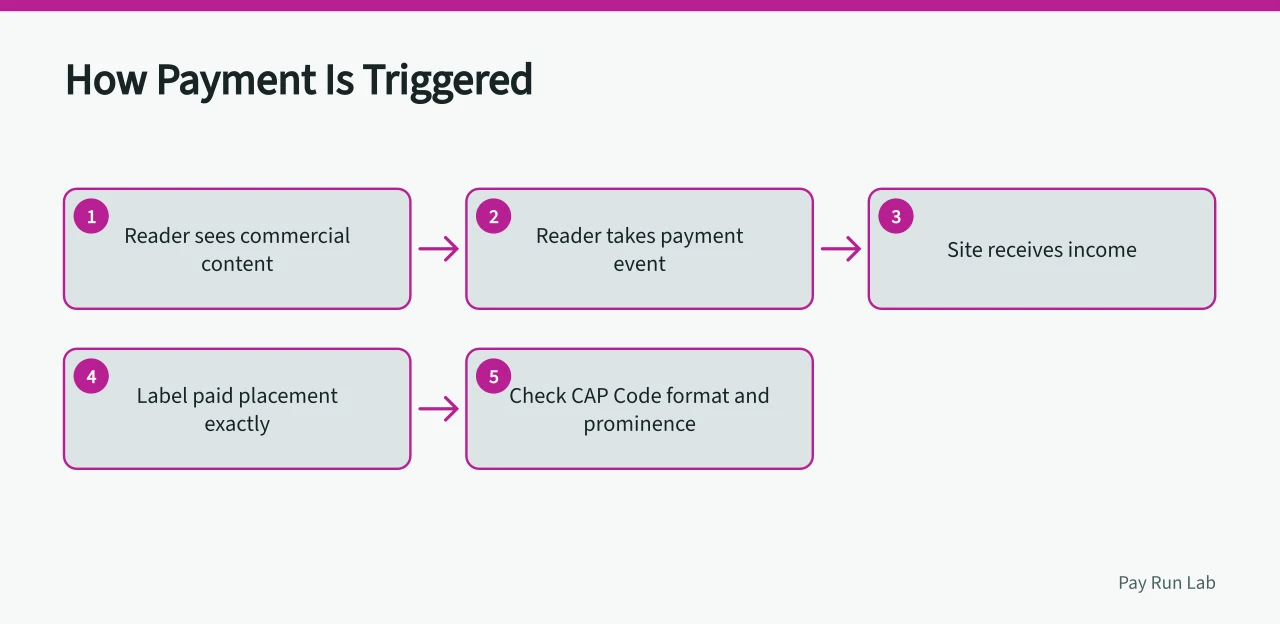
Explain the event that creates payment and whether it changes the customer's price. Do not call paid content independent.
The CAP Code (12th edition, effective 1 September 2010, as amended) applies to non-broadcast marketing communications, and its recognition of marketing communications rules define what falls within its remit. Check format and prominence with the current CAP Code and ASA guidance rather than relying on one standard label everywhere.
Research and comparison method
To complete the method disclosure, state the scenario, products, plans and evidence date.
A worked example: "Our comparison covers UK small employers with 1 to 50 employees, the leading payroll software products, their monthly plans, and evidence checked on the date shown. We use official records, supplier documents, controlled tests and customer research. Unknown information remains marked unknown."
State inclusion, exclusions, criteria, weighting, test environment, researcher, update schedule and limitations. Separate first-party claims from independently observed results.
HMRC's recognised payroll software list is one source for PAYE reporting capability. The page says HMRC does not recommend products. Do not imply that listing validates a publisher's rating.
Reviews and testimonials
Reviews must reflect genuine experience. Incentives, commercial relationships and material interests are disclosed. We do not write customer reviews of our own products or alter a quotation to change its meaning.
CAP's testimonials and endorsements guidance discusses evidence, permission, relevance and commercial interests. The CMA's reviews and endorsements collection links current consumer-law guidance, including fake-review responsibilities. This collection was last updated on 30 March 2023.
The CMA enforces consumer protection law, including the Consumer Protection from Unfair Trading Regulations 2008 and the Digital Markets, Competition and Consumers Act 2024. The ICO enforces the UK GDPR and Data Protection Act 2018 for personal data in reviews and testimonials. Determine whether consumer provisions apply to the specific audience and practice.
Accuracy, corrections and dates
To complete the corrections policy, state the error route and correction method.
A worked example: "Product features, prices, recognition and rules can change. We show the evidence date and recheck volatile facts before publication. Readers can report an error at the contact page. Material corrections are recorded in a log."
Define who triages a report, target response, when content is withdrawn and how past versions are preserved.
Limits and professional advice
Content is general information and does not replace tax, pensions, legal, employment, security or data-protection advice for a reader's circumstances. Product selection remains the customer's decision.
Do not use this wording to excuse careless claims. Review the policy whenever revenue, ownership, methodology or law changes.
Sample disclosure for an article
To complete the article disclosure, state the researcher, revenue trigger and any effect.
A worked example: "This page was researched by the editorial team using the method below. Affiliate commission may produce revenue if a reader buys software through a link. It did not change inclusion, order or score, except where a relationship is disclosed. Product facts and prices were checked on the evidence date. We did not test every product."
Place this near the comparison or recommendation. Link to the full method, but do not require that second page to reveal the fact that content is paid.
For comparison tables, place the disclosure directly above the table, not in a footnote. On mobile, keep the label visible without scrolling. In embedded third-party placements, repeat the disclosure in the embed itself, because a nearby label may disappear.
Governance record
Assign owners for commercial relationships, editorial method, claim evidence, review moderation and corrections. Require contributors to declare interests before an assignment and update them when circumstances change. Keep the declaration with the content record.
Test disclosures with typical readers. Ask who funded the page, how the publisher benefits and whether payment affects ranking. If answers differ from reality, revise wording or position.
Archive material changes to the policy with an effective date. Notify affected editors, affiliates and suppliers when the permitted wording or process changes.
Before you act
- Place the disclosure near the comparison or recommendation.
- Mark unknown information as unknown.
- Show the evidence date and recheck volatile facts.
- Define who triages error reports and the target response.
- Test disclosures with typical readers.
Common questions
How should a site describe the way it earns money?
State the income sources and whether they affect editorial choices. Explain what triggers payment and whether it changes the customer's price. Do not call paid content independent.
What must a comparison method section cover?
Cover the scenario, products, plans and evidence date. List sources and set out criteria, weighting, test environment, researcher, update schedule and limitations. Mark unknowns and separate claims from observations.
How should corrections and dates be handled?
Show the evidence date and recheck volatile facts. Give readers an error route. Define triage, response targets, withdrawal and version archiving. Record corrections and archive policy changes with an effective date.